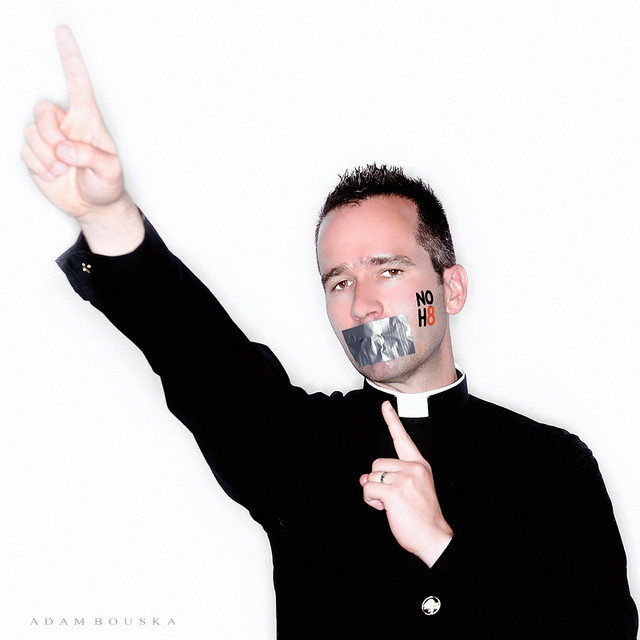
My journey as a gay Christian, and an ordained Anglican Priest, has been an interesting and - at times - a painful one. It's been a journey of discovering who I am, and who I was created to be. As a gay Christian, it saddens me that I sit in the middle of two communities that are often at war with each other. However, I've gradually learned that I needn't be apologetic for being gay, or for having a faith. It saddens me that there are so many people who use their faith as a justification for their bigotry, and seek to belittle, ostracise or oppress the LGBT community. That's not the expression of faith that I have, and it is for this reason that I posed for the NOH8 Campaign ... there is no room for hatred in my faith, and there shouldn't be room for it in our communities.
-Reverend Andy
Blogging about faith and the inclusion of the LGBT community in faith communities, and various other rantings & ravings.
Friday, 27 September 2013
No Room for Hatred in My Faith, by Revd. Andy | NOH8 Campaign
Wednesday, 14 August 2013
The Drag Circuit & the Imperial Court System ...
I had no idea that there is an Imperial court system in place for American, Mexican & Canadian drag queens, and was extremely impressed at how organised the structure is, and how much of a support the system is to those inside and outside it. They support a number of charitable organisations and - in addition to their fundraising shows and events, they donate of their own time, talents and possessions to support their communities and those in need.
As I reflected in one of my earlier posts, to illustrate the power of embracing this community and their community ethic, during my stay in San Francisco, I learned of St. Aidan's, an inclusive Episcopalian congregation in San Francisco that welcomes the local drag community into their midst and the drag community is encouraged to fund raise on their premises. The congregation of St. Aidan's has also raised funds for the drag queen's chosen charities. As a result of this mutually beneficial and generous relationship, the drag queens in turn largely funded the parish's food pantry for an entire year. To me, this is an example of the potential power that true inclusion holds to work for good in our communities.
I was trying to find the right words to explain a little bit more about the Imperial Court system, but decided that, rather than offer misleading information, it would be best summarised by simply quoting a leaflet I was handed at the coronation ceremony for the Alameda Ducal Court I had the privilege of attending before I left San Francisco:
About Latinos and the Imperial CourtsThe International Imperial Court System of the United States, Canada and Mexico was established in 1965 by a Latino, Jose Julio Sarria. There are Imperial Court chapters in over 68 cities within the United States, Canada and Mexico. Jose, who is now 91 years old and retired, appointed Nicole M. Ramirez, a well-known gay Latino activist, as his successor in 2007.
The Imperial Courts welcome everyone as members; gays, lesbians, transgender, bisexuals, heterosexuals, friends and family. The Imperial Courts membership is based on a Royal Court, with Dukes, Duchesses, Prince, Princess, etc., and is headed by an elected Emperor and Empress. Imperial Court memberships are all volunteer ... no one gets paid. The Imperial Courts hold events in the LGBT Communities and raise funds for charities and many causes, including children's charity concerns and student scholarships.
For more information, visit www.impcourt.org
Monday, 15 July 2013
Equality in Kansas
![]() |
| With Sarah |
![]() |
| The Equality House |
![]() |
| A sad group of people, centred around an angry, xenophobic old man. |
![]() |
| With Matthew Vines in Wichita |
Tuesday, 9 July 2013
Inclusive church in the community
My experience of ministering to the LGBT community back home is that - often - they don't want to be seen to be talking to a person of faith, because of the LGBT community's experiences of faith communities; how they've been vilified and ostracised, or at best - allowed into our churches or groups, and demonised and dehumanised. So, the two communities often have an inherent distrust of each other, which can make it very difficult to offer any authentic ministry to the LGBT community.
The ministry on the blanket had a sense of validity, through the hard work of the colleagues and friends I was gathered with ... they have spent a long time working in the community, and because of that, were able to be there without any sense of animosity or suspicion, which I think would be the case if a church group suddenly placed themselves in a park in the UK where the LGBT community was gathered to enjoy the sun. Through the way it has treated members of the LGBT community, the Church in the UK (capital 'C'), has largely lost it's credibility with the LGBT community (and it's not hard to see why).
![]() |
| On the blanket in Dolores Park, offering ministry to the community gathered. |
![]() |
| On the blanket in Dolores Park |
![]() |
| Some photos of some of the ladies of the Grand Ducal Council of San Francisco |
Monday, 8 July 2013
What does an inclusive church service look like?
I started the day at St Gregory of Nyssa, San Francisco, a community that actively advertises itself as inclusive of the LGBT community, reaches out to poor people (amongst other things, they run a food pantry where tons of groceries are shared out every week, and where those who come to get food items are as welcome in worship as they are for the food pantry!), and where people on the fringes in other parts of the Church are celebrated and included, not just in being welcome, but have the opportunity to use their gifts in positions of leadership. The worship space is in two sections, one section they use for the service of the Word (the readings, prayers & sermons), and the second section for the sacraments (the communion, or Eucharistic prayer).
The service involves lots of congregational singing, without instruments, and elements of the worship service are brought in from around the globe, with music bells and chants from other countries, and references to other cultures in items scattered around the church and also used in worship. The congregation sing most of the liturgy, and are encouraged to interact in other ways (such as touching the Scripture which is processed through the congregation after the readings, sharing their own understandings of the topic for the week with each other after the sermon has been preached, and offering up their prayers).
After the Word part of the service, the congregation sings and dances together to the altar, and gather around the central altar, and are surrounded by paintings of contemporary and traditional saints ... giving a sense of everyone being gathered together. The communion prayer includes more congregational singing, led by the choir, and the congregation are all invited to receive bread and wine, and to share it with each other.
I think that St. Gregory's own website can perhaps explain it in better detail than I have ... this is mixed in with my impressions. You can see more here.
Obviously, because of my context, what impressed me, was how LGBT folk are publicly encouraged to come and join in the community (even their business cards make mention of it - see below!), rather than the whole 'cloak and dagger' approach in the UK, which is too often the case. In the UK, there are LGBT inclusive churches, but in many cases an inclusive member of the clergy is not backed up by an inclusive congregation, or vice versa. So many LGBT folk may find a clergy person who is inclusive, but they can't be seen to be LGBT by the rest of the congregation, and so are able to attend ... but not able to be themselves.
![]() |
| A montage of the front and back of two of St Gregory of Nyssa's business cards |
This is truly affirming and inclusive. This is what the Church SHOULD look like. People should be able to attend, as themselves. People should be able to bring their whole lives into the worshipping community, and they should be able to offer their time, talents and gifts for the Kingdom.
This is a far cry from being allowed to attend ... quietly ... without standing out. A far cry from having to sit next to your partner, with no sign of affection between you, of pretending to be somebody else, so that people don't make you feel like a novelty or like an inferior Christian, because you're not able to overcome this modern 'affliction' of homosexuality. People should be encouraged, affirmed, blessed & encouraged to belong as WHOLE people, so that they can better be who they were created to be. We can't force beautifully created people into boxes that more easily fit our moulds.
This is what inclusive church looks like ... and it's utterly normal, and perfectly fabulous.
Here's a few pictures from the day ...
![]() |
| Where the service of the Word takes place. |
![]() |
| The octagonal space in which communion is celebrated. |
![]() |
| A montage of some of the wall panels. |
Saturday, 6 July 2013
Pause a moment in the Pink Triangle Park ...
It may not be large, or groomed, and sits right next to a busy road, and many seem not to be aware of it as they focus their attention on the bars, restaurants, cafés and stores, but it's a good reminder of how far we have come and how far we have yet to go in the pursuit of freedom and equality for LGBT people.
I don't think I could say it better than the Pink Triangle Park's own website, so - with apologies - I'll just paste the text from their website:
This is a civil rights park.
The 15 granite pylons rise before you in remembrance of the estimate 15,000 gays, lesbians, bisexuals and transgenders who were persecuted imprisoned and killed during and after the Nazi regime.
Throughout history, there are times when prejudice overwhelms all reason and humanity. Such was the case under the Nazis. But even after the Nazis' defeat, the discrimination against the LGBT community continued, using Paragraph 175 of the penal code. Briefly freed from concentration camps by Allied troops, those prisoners wearing the pink triangle were returned to finish their sentences. Those who survived two imprisonments emerged as second-class citizens even under democratically elected governments.
Pink Triangle Park and Memorial is a place of remembrance, reflection and education - a physical reminder of how persecution of any individual or single group of people inevitably damages all humanity.
San Fran, a city on the edge ...
Wednesday, 3 July 2013
Reflections on "Graced with light" by Anne Patterson, in Grace Cathedral, SFO
![]() |
| Looking up at the individual ribbons making up the completed piece. |
It's the little things ...
Like many other things in San Francisco, it made more of an impression than I thought. It struck me that it's a very small thing ... I little laminated sign in a window ... but it adds to lots more small things that make a big impression.
This is a city that, through hardship, has had to recognise that all people are equal, and that all need to be affirmed and included. Deeper than that, all need to be VALUED and PROTECTED. Many of our civil services, institutions and authorities now state (because the law requires them to), that they will accept LGBT people.
However, acceptance is quite passive, and implies that there's something to accept, because you wouldn't ordinarily be acceptable. You accept change, you accept hardship, you accept that occasionally you may have to put up with people you don't like. Acceptance does not say, "I value you," or "I celebrate you," or "I love you." It says, "I'm willing to put up with you."
It's an entirely different thing to recognise LGBT people, not as people who won't go away, but as valuable members of your community, with gifts and talents to bring, that are - not just welcome - but NECESSARY. To send out a message that says, "You are OUR people, we love you and we need you."
This is not about worrying about people flaunting their identity in your face, or worrying that they will appear too 'Gay' (or Bi or Trans or whatever), or that they will have questionable morals. This is not about any of that. This is about people having the freedom to be themselves without fear, about people feeling valued as valuable members of society, about people being respected members of society, about people being able to love and live, about BEING.
True inclusivity is not just acceptance. We need to go further than 'allowing' LGBT people into our communities and our churches. We need to go looking for them, we need to invite them in, we need to celebrate them, we need to use their gifts and their talents, and protect them as our own. That is inclusivity.
And, by the way, this would be the same for any institution ... I'm not picking on the Church ... merely mentioning it, because that is my context.
Monday, 1 July 2013
San Francisco Pride - a day to feel proud!
I have shared before that it's been a long time since I felt proud to be an Anglican ... the last time was probably as a teenager in South Africa, when I first became politically aware of the injustice of Apartheid, and saw the Anglican Church fighting against Apartheid, and also electing Archbishop Desmond Tutu as it's leader. Then, the Anglican Church I worshipped in, spoke out for minority groups, supported them, defended them and fought for their full inclusion and for their lives.
I can't remember feeling that same sense of lasting pride since then, and have often reflected that I feel shame about being an Anglican, and about affiliating with and serving an institution which has become so synonymous with the exclusion of the LGBT community in the UK, that it's difficult for the inclusive voices inside the organisation to make themselves heard, because people have stopped listening.
We all approach every situation in life with our previous experiences that have shaped and influenced us, and these guide our emotions. And so, I rejoiced at having the opportunity to march today, but was nervous about over-identifying with a denomination I've become wary of, regarding it's dealings with the LGBT community. I could not have been more wrong in this case, and in many ways, today I began to feel a certain pride at being an Anglican again. I was welcomed into the group, met some folk and was generously given a pair of rainbow wings by a member of the clergy, which added some much-needed to colour to my plain black clergy outfit. ;) I also met Diana Wheeler, of Oasis (the LGBT Ministry of the Diocese of California) and Sister Eden Asp, of the Sisters of Perpetual Indulgence.
![]() |
| My wings :) |
![]() |
| Me with Diana Wheeler & Sister Eden Asp |
We all joined together in singing All Are Welcome (by Marty Haugen), which caused a few to wander over and join in for the rest of the service. After the readings, The Right Revd. Mark Holmerud, Bishop of the Sierra Pacific Synod of the Evangelical Lutheran Church in America, preached about how marriage equality was long overdue, and offered his thanks for those who helped with the struggle. He reflected on the theme of this year's pride being, "Embrace, Encourage, Empower" and offered three other words; "Comfort, Control & Commitment". He mentioned that equal marriage opponents were no longer comfortable, wanted to regain control and were committed to removing equal marriage again, but that it was our calling to help them understand that they haven't lost anything, when everyone has gained so much. He finished by calling us to go out to love, to encourage, empower and embrace.
The service continued with the prayers, the peace, and the breaking and sharing of bread & wine, and finished with the words of the blessing:
Live without fear; your Creator has made you holy,
has always protected you, and loves you as a mother.
Go in peace to follow the good road and may God's blessing in the name of the Father, and of the Son, and of the Holy Spirit be with you always.
Amen"
![]() |
| The beginning of the Pride Mass |
![]() |
| Bishop Marc Andrus during the Eucharistic prayer |
I managed to chat to Bishop Marc Andrus and his wife, Sheila, about their ministry to the LGBT community, and their role in the fight to help bring Marriage Equality back to California. It was both humbling and encouraging to meet church leaders that were that committed to the full inclusion of the LGBT community that they not only opened church doors, but actively fought for their equality & inclusion.
![]() |
| Me with Bishop Marc Andrus and Revd. Thomas Jackson |
![]() |
| The Front of the bus |
Again, I think today made more of an impact on me than I thought it would, and will stick with me for years. The powerful witness and potential of an inclusive church should not be undermined. I suppose the challenge to the people out there is, when they find an inclusive church, attend it, and support it, because without that, they struggle to survive ... the churches that exclude the LGBT community are often very well funded and attended, but we need to be supporting the much smaller inclusive congregations, to get them to grow, and flourish, and witness about an inclusive faith.
A couple of things stood out for me today ...
- In my conversation with Bishop Marc Andrus, we reflected on the state of affairs in the Church of England, and I mentioned that one of the big differences, was that the Church of England was sometimes ACCEPTING of the LGBT community, but that that did not mean the same thing as WELCOMING them. And Bishop Marc went even further and said that there's a big difference between WELCOMING and INVITING. Inclusive churches can be found in the UK, but the Church of England seems to lack voices that are actually going out to the LGBT community and inviting them in, and welcoming them, and affirming them, and allowing them to bring their gifts and identities into our worshipping communities.
There is such a massive difference between accepting (a very passive thing), and actively inviting and welcoming, that I could write pages.
If people are invited, welcomed, affirmed and included - as themselves - they are encouraged to bring their gifts, they are energised, they are empowered, they are transformed, they bring their gifts to the table, and the community around them is enriched & grows.
If they're merely accepted, they *may* walk through the church doors, but they will keep their private lives and their identities hidden from those around them, and - as a result - they can never be full members, because they are not allowed to be full. - The second thing that really struck me, was when we marched by the Sisters of Perpetual Indulgence, and they thanked the bishop and the clergy for working so hard for the LGBT community. That really brought a tear to my eye, and made me proud - for today - to call myself an Episcopalian.
Sunday, 30 June 2013
Full-colour Pride
![]() |
| He was giving away free hugs. |
![]() |
| People as far as the eye can see |
![]() |
| Drumming group leading the parade onto the streets |
![]() |
| The start of the parade towards the Castro |
Thursday, 27 June 2013
Grace in Grace cathedral
Thursday, 20 June 2013
The start of the story
I'm about to start the travel section of my Sabbatical, and am more nervous than excited.
The reality of spending 6 weeks away from home, in a strange country, on my own is fairly daunting. You take a number of familiar things for granted ... knowing where to find groceries, where is safe and not safe to walk on your own, where to go to have time to think ... All of the little things that you know in your home town.
It'll be a wonderful experience, and I'll get to meet lovely people, I'm sure.
For now, I need to get everything into my bags and make sure I've got all my travel docs ... To quote Ab Fab, "Tickets, money, passport!"
Thursday, 13 June 2013
Inclusive faith groups need you ...
I don't believe the answer to fighting bigotry in faith groups is to silence the voice of faith. If we allow ourselves to go down that road, we effectively silence all faith voices, including those fighting hard to bring full equality and inclusion. People of faith who believe in equality for all often speak out in favour of full inclusion at the risk of their careers, and sometimes even their homes and families. If we're to bring change in faith communities and have faith communities that affirm and include all and advocate for equality, we're going to need to support them and help them find their voice. If we give them back their voice, it removes some of the power of the oppressive groups that seek to silence everyone that doesn't submit to their control.
- LGCM - the Lesbian & Gay Christian Movement.
Find out more about them here
Donate to their ministry here - Changing Attitude - Changing Attitude works for the full inclusion of gay, lesbian, bisexual
and transgender people in the life of the Anglican Communion.
Find out more about them here
Donate to their ministry here - Two:23 - an evangelical Christian with a LGBT inclusive ministry
Find out more about Two:23 here - Diverse Church - Diverse Church is a supportive community of 250+ young 18-30yo LGBT+ Christians, predominantly in UK evangelical churches. They aim to be a pastoral/mission resource
for the wider church.
Find out more about them here
- Inclusive Church - working for a church that is welcoming and open to all, and also holds a directory of inclusive churches nationwide.
Find out more about them here
Support their ministry here - Accepting Evangelicals - Accepting Evangelicals is a open network of Evangelical Christians who believe the time has come to move towards the acceptance of faithful, loving same-sex partnerships at every level of church life, and the development of a positive Christian ethic for gay, lesbian, bisexual and transgender people.
Find out more about them here - Metropolitan Community Church - a global inclusive church movement
You can read more about them here
Find their Western European & United Kingdom ministry groups here (you can support their ministries on their respective pages)
Support their global ministry here - Matthew Vines' Reformation Project
Matthew is a remarkable young man. There are plenty of people who have explained the theology behind inclusive Christianity, but Matthew is perhaps the first to make it available in a YouTube video, in the form of an hour-long lecture, that provides a brief summary of all Scriptural views of homosexuality. Matthew's page is here.
This video, and it's growth in global popularity, gave rise to a ministry by the name of
The Reformation Project - a Bible-based, Christian non-profit organisation that seeks to reform church teaching on sexual orientation and gender identity. Read more about this ministry here.
The Reformation Project is only available in the USA for now, but is hopefully coming to the UK soon.
Support Matthew's Reformation Project here.
I'm hoping to get the chance to meet Matthew at some point over the course of my Sabbatical, but obviously time-permitting for both of us.
- StonewallProbably the group many people think of first when thinking of a group working towards equality for LGBT people.
Find out more about Stonewall here
Find out about the many ways you can support Stonewall here.
Wednesday, 5 June 2013
Let the Sabbatical begin!!!!
We get the opportunity to take 3 months or so (again, it could differ from Diocese to Diocese), to look at study activities or life and faith experiences that will feed our ministry or our lives for the next ten years.
For some of my Sabbatical, I'll be enjoying spending time at home with my hubby, Mike, but I'll also be spending a large chunk of time in San Francisco in the USA, where I'm hoping to link up with various LGBT community and church groups, to look at good examples of inclusive ministry, in both the secular and religious communities. I've already made a contact with a few people in local churches there, and also in Grace Cathedral. I may look at attending services at one of theses, and also at observing some of their groups/meetings/people.
I'm also excited to have made initial contact with the Sisters of Perpetual Indulgence. Their story interests me, because what most people see is a group of cross-dressing men, in nuns habits, on in-line skates, but I think it's much deeper than that. They sit between two communities who often don't see eye-to-eye, i.e. the LGBT community and the religious community, and they've adopted the language and uniform of one, to do charitable works in the other. I hope I do get to meet them, and I'm looking forward to finding out what their experiences of both communities have been, and where their story started, and whether any lessons can be learned from them. In addition to all that, I think they'll bring some much-needed humour to my Sabbatical time.
I hope to be blogging / tweeting / photographing while I'm away, so do please follow, comment, feed back. If there are any people in the San Fran area that want to link up, I look forward to hearing from you.
At the end of my time in the USA, I'll be returning home, a weird mix of exhausted & exhilirated, and hope to have many tales to tell. :)