Sunday, 27 April 2014

Guest Post - "Tchaikovsky and my journey towards understanding my sexuality"

I have been asked to share the journey of a fellow minister, at the start of their ministry career.

So often in ministry, being honest comes at personal cost - to self and to career. For this reason, this is posted anonymously, but I do have contact with the author. Discussion welcome, but offensive remarks will be removed.

The post follows below:
_________________________________________________

My favourite composer is Pyotr Illyich Tchaikovsky. He's probably best know for his ballet suites these days: Swan Lake and The Nutcracker.

I adored Tchaikovsky's music long before I'd even heard his name. As I ten year old I had lots of his melodies and themes in my head. I know this because I distinctly recall singing the main theme of his Violin concerto, whilst dancing around my parents landing, dreaming I was hopelessly in love, alternating between singing the theme and doing forward rolls on the carpet until I was quite dizzy. There was no-one else around at the time, so I was totally uninhibited doing this.

My mum and dad love classical music. They took me to lots of formal concerts, and I had grown up playing the violin and piano. But it wasn't there that I grew to love the great Romantic composers. It was at home. Dad was very proud of his record deck and hi-fi, and as a family we spent several Winter evenings listening to symphonies and concertos by Beethoven, Sibelius, and of course Tchaikovsky, by the warm log fire.

It must have been in these times that I subliminally memorised virtually every theme from Tchaikovsky's Symphonies, concertos and ballet music. We didn't have a television, which I now feel was a huge blessing, not least because it meant that I didn't associate the melodies I heard with any cheesy TV adverts. As a 13 year old I was adamant  that the best composer ever was Tchaikovsky. There was a newsagent down the road – it sold classical CDs for 99p each (some company I discovered had gone bust). I would go after school and buy more and more. They weren't bad recordings either, and I built up quite a large collection. But my Tchaikovsky section was the biggest by far, as I bought every CD I could find by him in the shop: Swan Lake, Romeo and Juliet, the violin and piano concertos, and the symphonies. What surprised me most was that every time I played a “new” CD I recognised the theme. They were all in my brain somewhere, lodged away.

Of course, my musical friends tried to convince me that other composers were better – that the music of Bach was more clever and skilful, or that Mozart was more refined. I thought perhaps because I was a violinist I preferred string music to organs and pianos, but that wasn't quite it. Tchaikovsky was seen as emotional and youthful, but generally over the top – but that was exactly why I liked it. The soaring melodies, the unrestrained nature of it all felt to me like love ought to be. It felt truly Romantic – not in the clichéd sense of roses and trite words;  more like a roaring ocean, or a beautiful sunset on a beach, or somebody's smile. The Violin concerto theme painted a picture for me of having dinner with someone I loved, at the edge of a lake lit by moonlight, then rowing a boat out onto the lake afterwards. The tunes were memorable- you could hum along to them, and they were so unchecked. Compared to other composers, who seemed often bound by formal rules, Tchaikovsky's music felt to me like the difference between a formal kiss on the cheek given to greet a guest at a dinner party, or a passionate kiss between two lovers.

I only began to discover my sexuality later in life, from when I was 16, and although looking back I can clearly see that I was gay, I was reluctant to acknowledge this to myself until I was a good few years older. The discovery that I had a homosexual orientation crept up on me, and I repressed it for many years, packaging it away it in the box of “negative temptation”. Certainly it didn't help that it felt to me that gay people (and activists in particular) were perceived as Public Enemy Number One by some of my close family, who saw them as undermining the church. Because of this I dared not open up to them about my own desires and gay attractions towards men. My parents also, I later discovered, didn't seem to really believe in sexual orientation at all, and just saw homosexual attraction as a “phase.”

I couldn't admit to my friends either that I was attracted to guys (especially not the one I was in fact attracted to). It didn't help that I was at an all boys grammar school where to admit to being gay would probably have been social suicide at the time. Even as a 17 year old, when I thought I was respected and safe from peer pressure, I made a mistake of looking down at a DVD in HMV from the gay cinema section, when we were out on a history trip. I thought I'd got away without being spotted, but one of my classmates caught me and despite flatly denying it to my friends I was then known at school as “gay cinema boy”.

But when I was 17, in a General Studies class, one of my teachers (actually the French teacher) played us all a Tchaikovsky Symphony. It was the 2nd movement of his Fifth Symphony, one I had in my collection, and I knew the main tune. But before playing it, he told us something that staggered me. He said that Tchaikovsky was gay. He also said that the pressures of the Tsarist Russian society he lived in (in one sense different from Soviet society today, but still pretty oppressive), coupled with his family's expectations of marriage, fuelled a deep depression in Tchaikovsky. His desire to love another man was doomed in the context of the time and place he was living in.

My teacher then explained that in this symphony the beautiful love theme is destroyed by the interruption of harsh trumpets. Out of a heartfelt desire to teach us not to be homophobic, by using this piece of music, my teacher was also explaining that Tchaikovsky was tormented by knowledge of his being gay and that his dreams of love were dashed once and for all.

I listened to the music, and I was staggered. There it was, the beautiful melody I knew well – but just as my teacher said, the trumpets kept bursting in, time and again – ending and disrupting it. I was shocked – it all seemed so tragic that a beautiful thing was being destroyed in this way.

Over the next ten years, I grew to a greater understanding of my being gay, and I experienced the pressures of a conservative Christian culture that seemed to want me to deny my emotions and desires, and continually ward me off from any romantic longings I might have. It helped me to continued to reflect on Tchaikovsky's music, and understand what it meant.

Last week, I picked up a biography of Tchaikovsky's, written by Anthony Holden. Like any biography, it has its opponents – people who said that Tchaikovsky's sexuality wasn't as big a theme  as Holden was making out, and so forth. But the real words from Tchaikovsky's letters strike a chord with me. Towards the end of his life, he wrote, “My whole life has been a chain of misfortunes because of my sexuality”. (To date, Russia refuses to allow this letter to be published, according to Holden).

Living as a young(ish) gay Christian starting out as a church leader is hard. Sometimes it feels like the melody of my soul, longing for love, represented by the melody of the strings is being shouted down by those brash trumpet players. (I don't mean any offence to brass players in general – well not too much, I am a biased string player!) I continue to empathise with Tchaikovsky. In fact, I think that in some sense, if anyone wants to understand who I am and where I am coming from, they should listen to the climax of the 2nd movement of Tchaikovsky's 5th Symphony.

(There is quite a good version of the movement at https://www.youtube.com/watch?v=4jSki-VP6fE. To get the full idea of what I'm talking about, its best to listen to the full 12 minutes. But the key moments I am talking about. are when the brass bursts in at 6:37, and more crucially, 10:12. Turn your volume up and you'll get what I mean.)

But I also need to remind myself that Tchaikovsky's troubled life and sad end (he died of cholera, perhaps self-induced as he refused to take steps to boil his water to prevent catching it) is not the way that my life should go. The theme of many of Tchaikovsky's ballets (Romeo and Juliet, Swan Lake) is that in spite of death, love conquers. As a Christian, I believe that Jesus defeated death, and conquered it through his love. That is the message of resurrection, and that is what gives me hope to let my loving desires, my loving gay desires, to overrule the temptation to slip into a life of loneliness, isolation, shame and bitterness. 

Tchaikovsky was private man, who wanted to hide his sexuality, because he thought it was a shameful thing. He said in letters, “The notion that one day people will try to probe into the private world of my thoughts and feelings, into everything I have so carefully hidden throughout my life, is very sad and unpleasant.” But I for one, am glad to have known of the anguish he experienced and the struggles he faced. For me to, my sexuality is a personal thing, but I find myself more and more driven to move into the open (and even under the spotlight) to challenge the injustices of this world.

And until this world understands, I will continue to think of Tchaikovsky, and listen to my favourite composer. Because love does conquer all.

Friday, 18 April 2014

Good Friday

On Maundy Thursday, I attended our Diocesan Chrism Eucharist, where clergy and lay ministers from around the Diocese gather around their bishop and reaffirm the vows they took when they were licensed or ordained. At this service, the bishop also blesses the oils that are used for the following year for the anointing of the sick & dying, for baptisms and for confirmations.

I made the decision to attend in my rainbow dog collar, to be a present reminder of the countless LGBT Christians who exist in our churches all over the world, who don't have a voice, who are silent for fear of judgement or exclusion, or who are known to be LGBT, but asked to hide themselves, lest it be an embarrassment to the Church or draw attention to themselves (so much for 'come as you are'!).

I didn't make the decision to attend in my rainbow collar easily; I was aware that some may see it as campaigning during what should be a spiritual moment. I did it, though, because we come as ourselves, and can't separate out the bits that other people find less offensive, and because I thought that the LGBT community is so often silenced by others in churches, it could help someone else who was present that may be feeling disenfranchised and distanced.

On my way to the Chrism Eucharist, in rainbow dog collar.
At the service, it was noticed by some of the clergy around me, who said they loved it, and a couple of young mums behind me, who said that they loved it as well, and what it stood for. Others either didn't notice, or chose not to comment.

I've been reflecting on the Easter message this year, and I've been identifying a lot more with it than in previous years.  It's struck me that there is much in the Easter story that the LGBT community can identify with ... hidden identities, expectation to conform, being outside the acceptable institution, and finally - the journey from being welcomed to being vilified, rejected & hated (& in too many cases, pursued & sentenced to death).

It strikes me as interesting that people lean heavily on the "clobber verses" against homosexuality (many of them in chapters that also condemn other behaviour they overlook), but yet Jesus said nothing about the matter ... He did, however, have a lot to say about religious zealotry.  Anyway, I've covered a lot in the past about these particular verses, so if you'd like to read more about them, I'll provide two links here:
First, the wonderful lecture by Matthew Vines, on YouTube, here; and
Second, an article by Daniel Payne, here.

So, because I've been reflecting a lot on the relevance of the Easter Message for LGBT Christians this year, I offer here a prayer for Good Friday, from Dorothy McRae-McMahon, whose liturgical resources I come back to, time and time again.  If you're not yet familiar with her work, it's worth looking at.
_______________________________________________

Prayer of Confession
God who never turns away from us in rejecting judgement,
we enter this day as the one
where we are invited to look deeply into our lives.
Embrace us with your costly love as we face our realities -
the tough truth about ourselves
which stands stark and clear before your cross.

Loving Jesus, we grieve our constant failure
to be your true people.
Our lives are often limited by our own concerns
and closed off by prejudice and ignorance.

Show to us our self-righteousness as we tell ourselves
that we are the chosen ones in this world.
Break through our self-deception
so that we may see ourselves as ordinary human beings,
those who share in the crucifying of good
and who are far more dependent on your grace than we will
      ever own.

Forgive us, O God:
For we know not what we do
and we know not what we have done.
Amen.

Words of assurance
The God who hangs before us in suffering and death
is the God who would rather die than stop loving us
and who offers us forgiveness.
As we stand before the grandeur of his love,
let us receive the pardon of the Christ and live as people
who walk in faith towards Easter Day.
Amen.

Prayer of Thanksgiving
We thank you, O God,
that you travel with us down the days of life,
entering the places which we dread
and staying in the darkness and emptiness alongside us.
We will never forget your kindness in our every moment, loving Jesus.
We thank you on this day, Jesus Christ,
for love which surpasses human knowledge
and grace which bears the pain of death.
Amen.

Prayer of intercession
On this day, of all days, O God,
we bring to you all the oppressions and suffering in this troubled world.
We do this in confidence,
knowing that nothing is too much or too little for you:

[Personal prayers]
Gather up all of these, our prayers,
into the loving healing and costly carrying of pain
which lies within your own Body, Jesus Christ,
that soon all may be changed into new life.
And now we pray that we, as your earthly Body,
may so be transformed and inspired by your love for us,
that we too may absorb into our life the needs and struggles of the world
and create there a miracle of grace
and a leading forth into a different day.
In the silence,
we honour all that you have done for us and for all people:

Give us faith to believe in a love as great as yours, O Christ.
Amen.

Commissioning
Go out in quiet faith
to walk the way towards the hope of Easter Day
and our meeting with the risen Christ.

                                                                 (McRae-McMahon, D. 2006. Liturgies for High Days. London: SPCK)

xXx

Saturday, 29 March 2014

Praise God for Same-Sex Marriages

Today, for the first time in the UK, same-sex couples can be legally married.  This is a wonderful victory for equality, and something to be celebrated.  God's grace, gifts & sacraments should be available to all.

On this momentous day, I'd like to offer a prayer and a blessing for all those who will be entering into marriages ...
________________________________________________________

Prayer:
Eternal God, creator and preserver of all life, author of salvation, and giver of all grace: Look with favour upon the world you have made, and especially upon those who will be committing to a life of love together from today.

Give them wisdom and devotion in the ordering of their common life, that each may be to the other a strength in need, a counsellor in perplexity, a comfort in sorrow, and a companion in joy.  Grant that their wills may be so knit together in your will, and their spirits in your spirit, that they may grow in love and peace with you and one another all the days of their life.

Give them grace, when they hurt each other, to recognise and acknowledge their fault, and to seek each other’s forgiveness and yours.


Make their life together a sign of Christ’s love to this sinful and broken world, that unity may overcome estrangement, forgiveness heal guilt, and joy conquer despair.  Give them such fulfilment of their mutual affection that they may reach out in love and concern for others. Protect them from those who would wish them harm, and surround them with your grace and a community that loves and supports them.

Grant that the bonds of our common humanity, by which all your children are united to one another, and the living to the dead, may be so transformed by your grace, that your will may be done now and forever; through Jesus Christ, our Saviour.

Amen.

Blessing:
May the blessing of God surround us
May angels and friends share our journey
May we be wise and strong and creative
May we celebrate life and hope
May we walk peacefully with Mother Earth.
May God’s image grow within us
May laughter and courage heal us
May the gospel of life sustain us
All the days of our journey home.
And may my own blessing be yours;
A blessing rooted in our common pilgrimage
The blessing of a friend.
Amen
________________________________________________________

 Prayer, adapted from:
Ward, H. & Wild, J. (eds). Human Rites. Mowbray. 1995
 Blessing taken from:
The Iona Community; The Pattern of our Days. Wild Goose Pulbications. 1997
Burgess, R. & Galloway, K. (eds); Praying for the Dawn. Wild Goose Publications. 2000
Ward, H., Wild, J. & Morley, J. (eds); Celebrating Women. SPCK. 1995

Wednesday, 26 March 2014

LGBTI Anglican Coalition's response to the House of Bishops's "Pastoral" Guidance

LGBTI Anglican Coalition
www.lgbtac.org.uk contact@lgbtac.org.uk
_______________________________________________________________________________________________________________________________
21 February 2014. LGBTI Anglican Coalition Open Letter to House Of Bishops Regarding Pastoral Guidance On Same Sex Marriage, Issued 14 February 2014

Dear Bishops
As you are aware, the letter issued by the House of Bishops on St Valentine’s Day has profoundly undermined the hopes expressed by the Archbishop of Canterbury and others for “good disagreement”. The image of the church in wider society has been further damaged, with headline messages such as ‘Church of England in snub to gay community’.

We remain committed to the need for prayer and facilitated conversations, as recommended in the Pilling Report and requested by the Church of England. However, it is hard to see how such conversations can be productive, in the light of this statement. In an attempt to re‐establish some positive foundations, we request answers to the following questions:

First, we note the traditional Anglican ‘insistence upon the duty of thinking and learning as essential elements in the Christian life’ (Lambeth Conference 1930) and ‘facing with intellectual integrity the questions raised by modern knowledge’ (Lambeth 1958), which has led to change on such matters as contraception. Please could you clarify how the House of Bishops has sought to inform itself in a systematic way of the work of the numerous Anglican and other theologians from 1940 onwards who have argued that loving committed same‐sex partnerships should be affirmed, and demonstrate that it has seriously considered the arguments of more than a handful of these before issuing statements such as this pastoral guidance?

Secondly, in view of repeated calls from the Lambeth Conference since 1978 for deep study of sexuality, including dialogue with homosexual people, echoed by the Church of England from 1979, please could you explain how the findings from subsequent dialogue with lesbian, gay, bisexual, transgender and intersex (LGBTI) people and wider discussion have been collected by, and informed the thinking of, the House of Bishops?

Thirdly, given that the 1988 Lambeth Conference urged that such study and reflection take account of ‘the socio‐cultural factors that lead to the different attitudes in the provinces of our Communion’, how has the House of Bishops approached the difficult task of seeking to understand the socio‐cultural factors which might have influenced its members’ views on sexual ethics?

Fourthly, what efforts have been made to gather and analyse the comments of those who have studied Issues in human sexuality and Men and women in marriage, and how have the findings been taken into account in this pastoral statement?

Fifthly, as you know, there are many LGBTI clergy who, in good conscience seeking to model their household according to the way of Christ, are intending to marry or to convert their civil partnership to marriage. How will you ensure that these clergy can contribute fully and equally to the proposed discussions, without fear of sanction?

Finally, we would ask how you intend to resolve the issues of the presumed bipolarity of male and female in gender and sexual orientations and in their relationships in the light of the latest scientific and theological knowledge, so that all people, intersex, transgendered, lesbian, gay, bisexual and heterosexual, who seek to enter committed, loving and faithful relationships can find their rightful place within a renewed church which draws its teaching from the New Covenant and the unconditional love of Christ?

Yours sincerely
Mike Dark and John Blowers,
Joint‐Chair, LGBTI Anglican Coalition.

END


Member Groups
The Anglican Coalition provides UK based Christian LGBTI organisations with opportunities to create resources for the Anglican community and to develop a shared voice for the full acceptance of LGBTI people in the Anglican Communion.

The Group Members are as follows:
Accepting Evangelicals is a open network of Evangelical Christians who believe the time has come to move towards the acceptance of faithful, loving same‐sex partnerships at every level of church life.
http://www.acceptingevangelicals.org

Changing Attitude is a campaigning group drawn by God’s love to work for the full inclusion of lesbian, gay, bisexual and transgender people in the Anglican Communion.
http://www.changingattitude.org.uk

The Evangelical Fellowship for Lesbian and Gay Christians (EFLGC), formed in 1979, is a group of women and men, most of whom are lesbian, gay or bisexual and come from an evangelical Christian background.
http://www.eflgc.org.uk

Inclusive Church is a network of individuals and organisations working to break down the barriers to full inclusion at all levels of the Church of England.
http://www.inclusive‐church.org.uk

The Lesbian and Gay Christian Movement is a UK‐based international Charity which challenges
homophobia and transphobia, especially within the Church and faith based organisations.
http://lgcm.org.uk

The Sibyls is a UK‐based confidential Christian spirituality group for transgender people, and their
supporters.
http://www.sibyls.co.uk

The Two:23 Network is a new network of Christians, connected by LGBT issues that aims to include and encourage all to discover the love of God for themselves, pursue the call of Christ and live in a way that cherishes others just as God cherishes us. It has developed from the LGBT‐affirming ministry of Courage.
http://two23.net/

THE UK Intersex Association Intersex people are individuals whose anatomy or physiology differ from contemporary cultural stereotypes of what constitute typical male and female. The United Kingdom Intersex Association (UKIA) is an education, advocacy, campaigning and support organisation which works on behalf of Intersex people.
http://www.ukia.co.uk/

My response to the House of Bishops' "Pastoral" Guidance

On 15 February, the House of Bishops released their "Pastoral" Guidance on Same Sex Marriage (text here).  That they would draw up the document on Valentine's Day is a kick in the teeth, that they would embargo it until the next day is less than honest.

Following on from an article in the Church Times, where I offered my view on the House of Bishops' "Pastoral" Guidance (see a copy here), I'd like to add to what I expressed there, and give some context.

Two sections are of particular interest to me:
Acts of worship following civil same sex weddings
21.  The same approach as commended in the 2005 statement should therefore apply to couples who enter same-sex marriage, on the assumption that any prayer will be accompanied by pastoral discussion of the church's teaching and their reasons for departing from it. Services of blessing should not be provided. Clergy should respond pastorally and sensitively in other ways.Clergy and ordinands
27.  The House is not, therefore, willing for those who are in a same sex marriage to be ordained to any of the three orders of ministry. In addition it considers that it would not be appropriate conduct for someone in holy orders to enter into a same sex marriage, given the need for clergy to model the Church's teaching in their lives.
When it comes to equality, unless we are capable of preaching a positive message, we are - in fact - preaching a negative one.  If you produce something that mentions that the LGBT community and/or their relationships are a deviation from the norm, it will be used to oppress people.

As a Church, surely we have to be sending out a message that affirms, includes & CELEBRATES our LGBT community - their gifts, talents, hopes & dreams & their desire to commit to loving same-sex partners that will benefit their local community & our faith communities.

Currently, the message being given out is that we endure or tolerate our LGBT members ... which is a negative message, not a positive one.  You tolerate or endure an illness or a mouth ulcer, not a human being.

What's more, if you send out a message of tolerating or enduring someone, you're encouraging them to see themselves as a burden, as somehow less worthy than other members of the community, thereby adding to issues of self-worth and mental health. I believe the Church should be affirming and blessing people, not making them feel inferior or imperfect.

Sadly, though, once again, we are being asked to create an "Us and them" mindset. We are being asked to make the LGBT people in our congregations feel inferior by discussing with them how they've departed from Church teaching.  There are those that can, by their nature, live within Church teaching, and those who now, simply because of who they are, can never comply with it.

There is no way that church can be a welcoming place, while the institution aims to highlight the reasons why you are departing from Church teaching, rather than celebrate your presence & your gifts.  In addition, this difference which we are being asked to highlight will, in effect, enable others to discriminate against LGBT church members.
_________________________________________________________________________

To illustrate, I'll share some of my experiences under "Issues in Human Sexuality".  "Issues" was a guide to facilitate discussion in the Church on sexuality.

In reality, many Diocesan bishops, Diocesan Directors of Ordination and clergy used it as ratification to enforce their own bigoted views, and discipline anyone who didn't comply.  It was treated as Canon Law, rather than a discussion document. 

           I came to faith at the age of 17, and - at the age of 18 - entered into full-time ministry as a Pioneer Youth Worker & missionary in disadvantaged rural communities in South Africa.  From there, I entered into employment as a full-time Youth Pastor in my home diocese, where I worked for 6 years, developing a ministry across the city and across the diocese; training youth pastors, and running regional youth camps and mission and evangelism initiatives in several local schools, and - together with non-denominational groups - ran programmes that ministered to thousands of young people across the city over the summer holiday period.  I ran teen groups, junior groups, toddler groups, young adult groups and student groups, ran training events for youth groups and youth pastors.

            At the same time, I was struggling with my own sexual identity, but was aware of the wretched “Issues in Human Sexuality” document, and so remained celibate and desperately lonely, and even subjected myself to 3 years of reparative therapy and support groups aimed at making me straight.  They were the 3 single most miserable years of my life, where I began to believe that I either didn’t have enough faith to change who I was, or didn’t matter enough to God to be granted a change.  I lost contact with my family (the group & counsellor’s advice was that I was gay by nurture, and that I needed to distance myself from those that had caused me to have this “broken identity”), and I remember sharing with a friend that the only reason I did not commit suicide, was because I believed the hell I found myself in was somehow better than the hell I would go to for being gay.

            By this stage, I was also juggling a Theology degree by distance learning, and the Diocese had ordained me to the diaconate, and I was serving my curacy.  At my lowest point, my training rector asked me to confide in him what was going on in my private life, and I shared what I was feeling, grateful to get it out in the open.

            What followed was a systematic breakdown of my private and professional life; I was subjected to him spreading rumours about me around the parish, trying to force me into a relationship with the parish youth worker and - when we both refused - he tried to force us to cohabit in the parish house, he had public notices about me pinned to external noticeboards, stating that I had strayed and needed to be disciplined.

            When I approached the Diocese for help, I was reminded that rank mattered more than integrity, & was told that - as the junior priest - I would need to be disciplined.  I was removed from post and given 3 weeks to vacate the parish house, with no post to go to.

            Thankfully, I had the opportunity to leave there, and move to the UK.  After 9 years of ministry in that Diocese, the only sentence in my reference stated that, “it has come to our attention that this priest is gay, but this has not proven a problem yet.”

            That, thankfully is behind me, and I’m at peace with myself, and my identity, and am able to see that I am exactly as God intended me to be.  However, I offer all of that, as evidence of how misused “Issues in Human Sexuality” could be.  My superiors in that Diocese saw no incongruence between scripture and the way that they were acting, and “Issues in Human Sexuality” gave them the permission they needed to act in that way, and do so boldly.
 _________________________________________________________________________

I think the House of Bishops forgets how diverse the Church is, and how very differently authority, hierarchy, theology, exegesis and practical application are treated around the world.  I sincerely hope this is not the case, but there will probably be places where the new guidance is going to be used for a witch-hunt of LGBT clergy & parishioners.

In the same way that "Issues" gave bullies and bigots the permission they needed to oppress & punish people within their churches, the new "Pastoral" guidance will give them the permission they need to discipline and shame clergy.

LGBT Clergy often cannot safely engage in the debate about this matter, because being outspoken comes at a price to your career.  If you're not sidelined by your colleagues, you're overlooked for senior posts.  How can free and fair debate take place, when one side is allowed to be as outspoken as they wish, and the other fears for their careers, their families and their lives?

These are dangerous times for young LGBT Christians in many of our churches ... having been discredited and banned by professional psychotherapy & counselling bodies in the West, we're seeing an increase in courses in Reparative Therapy (and even Aversion therapy) being offered in churches across the world, where these harmful (& sometimes fatal) treatments can operate without regulation.

This is not a time where the Church can afford to be anything less than welcoming and affirming to the LGBT community.

If you have a voice, please do use it ... write to the Editor of the Church Times, or your faith / denomination newsletter.  For too long, people have been making decisions about the LGBT community without considering or consulting us.  That needs to stop for true communication and change to happen.

Wednesday, 19 March 2014

Help bring an end to the #GayBloodBan!

When I've challenged the National Blood Service's ban on gay blood in the past, I've received the same dodgy response each time (on one occasion, it was a skew photocopied note that had been typed on a typewriter - this was 2005).  When challenged, their response is that there is evidence that tells them that gay blood is a higher risk group, and therefore they ban all gay blood. The evidence referred to is often from decades ago.

They now proudly state that they've partially lifted the ban to allow gay men to donate blood, as long as they've been celibate for a full 12 months prior to the donation date.

However, that makes no sense. All blood should be tested routinely anyway, and safe sex is much more prevalent in the gay community than it is in the straight community. So, there is no basis for the National Blood Service's ban on gay blood, other than discrimination.

Gay men are excluded if they have sex, even protected sex, with a lifelong partner - even once - in the 12 month period before the donation date. Straight men who have unprotected sex with numerous partners can donate freely.
That's purposely placing an impossible hurdle in the way of gay men, purely to exclude them from donation.

Read this Pink News article about the petition, and then sign this petition to help bring a stop to this nonsensical ban which is discriminatory & adds to the blood shortage ... http://www.gopetition.com/petitions/allow-gay-and-bisexual-men-to-donate-blood-in-britain.html

Saturday, 8 March 2014

Happy International Women's Day

With gratitude for the women who have played, and play, a role in shaping my life.

This list obviously includes my mother, who instilled the virtues of right & wrong in me, taught me how to manage my life and my household, taught me to cook, iron, clean, but also taught me how to assert myself, have a good argument, make my will known and stand firm.  When we were victims of the economic downturn in South Africa in the late 1980's, Mom was the one who swallowed pride and went looking for food with cap in hand, and we survived for several months on regular deliveries of food donations from our local Catholic church.

The list of influential women extends beyond to include teachers, inspirational friends, clergy, colleagues, nuns, cleaners, pioneers, and more.

The most inspirational teachers in my life were women; from Miss Kelleher who instilled a desire to work meticulously (albeit slowly) on my studies, to Miss Fleming & Miss Von Zeuner who showed me at the age of 12 how to begin to think independently when it came to politics (I was schooled during the apartheid era, which I knew was desperately wrong, but was not aware at the time that you could voice that you disagreed with the government, or that enough voices could change a country. These two teachers took a great risk by encouraging discussions in their classes that would not have been allowed by the school, and encouraged us to find our own voices);
The first person I came out to was a female friend - who helped me see that it wasn't a big deal - I was still the same person.
When my training incumbent subjected me to public humiliation when he discovered I was gay, and began a systematic breakdown of my career, including kicking me out of the parish, making me pay off a 3-yr car loan in 3 weeks, spreading rumours about me around the parish, pinning notices about me to public noticeboards, having me followed around town on days off and in the evenings, and more, it was a female friend who came to my rescue and paid for me to fly to her and stay with her, and who helped me see that my calling was a calling to serve God, not necessarily with a dog collar.
I have learned a lot about ministry from the women in my profession, who have been excluded from playing the institutional game, which made them easier to confide in and befriend. That's not to say that I haven't learn from men in ministry, particularly those who were around during my training years.  However, as people who have also often been sidelined by the official institution, the female ministers I've known have been both colleagues and confidantes, and I'm grateful for them.

This list is a starting point, there are so many more, from church cleaners who taught me about integrity & friendship that crosses income barriers, to parishioners who showed me different models of family & how to raise children (who knows, a skill I may yet need), to those who were, and still are, pioneers in male-dominated workplaces.

I should mention that I've long had a real respect and admiration for African women, those I met, and those I didn't, who - during the dreaded apartheid years, left their own families to be the nanny, cleaner, cook & household manager for white families, in order to provide for their own families. I'm astounded and humbled that they would do that, and often raise someone else's children without prejudice or agenda.

So, happy Women's Day, and I hope to live to see the day when we no longer need a Women's Day, or Pride festivals.

Thursday, 6 February 2014

Russia's ruthless victimisation of it's LGBT community

Watching Hunted on Channel 4 Dispatches tonight was truly chilling.

Using Russia's anti-gay law (allegedly only aimed at silencing gay propaganda), gay people are being hunted openly like prey, being kicked, beaten, humiliated, raped with sticks & bottles, made to drink urine, shot at and killed.

Russia doesn't have a law that covers hate crimes ... We were shown a man that was filmed shooting a gay man in the face was let off with a suspended sentence for hooliganism.  Another man went to court for attacking a gay man with a stick, with clear photographic evidence provided ... his case has been postponed for 18 months and he walked free.  His victim was taunted and humiliated outside the courtroom.  When it gets to 24 months the case will be chucked out.  A group of guys hung around outside an LGBT film festival, taunting women entering the building, offering them corrective rape, and "gift" bags containing rope, soap and a card instructing them to kill themselves and cleanse the world of their "filth".

Russia is lawless, without mercy, without any decent human rights & without a conscience, and sending any athletes or tourists to such a place is irresponsible.

What's more chilling than Russia's cruel & inhumane treatment of it's LGBT community, is how many countries & big corporations choose to stay silent. Coca Cola and McDonalds, as sponsors for the Sochi Winter Olympics, have remained consistently silent on Russia's appalling treatment of it's LGBT community, ignoring pleas to speak out.  In addition, both have had very embarrassing PR battles where they've missed opportunities to respond to a lot of negative publicity (or - in Coca Cola's case - one publicity stunt even fed homophobia ... and rather than correct the error, they took the site down, and made some thin statement about standing for equality.  However, these statements are empty unless they actually STAND for equality.

Thankfully, some companies are now beginning to speak out ... among them AT&T (article here) & a neat little publicity stunt by Brewdog Brewery in Scotland (article here). In addition, major US investors are now adding their voice to the throng calling for large corporations to hold Russia accountable, rather than pour money into a country which is hunting & victimising the LGBT community (article here).

If you want to view the programme, here's a link to the video.  If that link doesn't work, it may be that you need to go to the Channel 4 Dispatches website (here) and search for "Hunted".

Friday, 29 November 2013

The value of Straight Allies ...

I was recently asked to comment on a piece of writing about reforming the Church's views on the LGBT community, and replied as follows.  I thought I'd offer it on here as an encouragement to stay involved.

As a gay person in the Church, I find that it becomes so tiring fighting for the right to simply be, that it often becomes fairly impossible to engage in any useful way in theological discussions about the matter.

People forget (or, if I'm being generous, don't know), that this is an issue of human identity; that sexual identity issues are at the very core of who you are, not a simple matter of "keep it in your trousers".  It's about who you love, how you interpret your place in society, your gifts and talents, what influences your interests and decision-making, and how you express yourself, and so much more ... that to be reduced to a mere extension of your genitals is dehumanising, devaluing, and robs you of the opportunity to engage as an equal partner in discussions about your place in society.

So, to be caught on the back foot all the time, defending your right to participate in the discussion, is exhausting, and can leave you too exhausted to play any useful part.  For this reason, the value of allies of the LGBT (and Q and I) community cannot be overstated, and we desperately need more.

You don't have to be Lesbian, Gay, Bisexual, Transsexual, Queer, Questioning, Intersex or indeed even Asexual to be engaging in the discussions about bringing change and equality in our communities and institutions.  Thank you to all the straight allies that are engaged ... please keep it up.  We need your voice.

Image from this page.

Resources:
Here's a link to download the Stonewall guide about Straight Allies.
A link to download the PFLAG guide about Straight Allies.
The Wikipedia article about Straight Allies


Saturday, 28 September 2013

My thoughts on cases involving Christian B&B owners ...

I often get asked for my opinion on the legal cases involving Christian business owners & equality legislation. I think it's a sort of spiritual litmus test that the askers (sometimes students, sometimes strangers, sometimes Christian, sometimes not) use to gauge my theological views, without directly asking me if I'm gay, or pro-gay.

There has been much publicity around the case of Peter & Hazelmary Bull, the Christian B&B owners who turned away Steven Preddy and Martyn Hall, a gay couple who are in a Civil Partnership, because they didn't allow unmarried couples to share a room (for eg., here are links in the Huffington Post & the Pink News). There was also a lot of publicity around the case of Susanne Wilkinson, a B&B owner in Berkshire who turned awayMichael Black and John Morgan, a gay couple on the basis of their sexuality.

Susanne Wilkinson's case happened about a year before the Bulls', so I'll focus more on the Bulls, as their case is more recent. The Bulls argued that they turned Steven & Martyn away because they have a policy of not allowing unmarried couples to share a room in their B&B, and Steven & Martyn weren't married, therefore were turned away.  The problem with that is that that in itself is illegal ... you can't turn away unmarried couples if you run a B&B, but even more so, because Steven & Martyn were as married as they could legally be at the time as a gay couple. They were a legally committed couple, in a monogamous relationship, and yet were still turned away.  This suggests that they were turned away for being gay, which is also illegal.

The case presents an interesting dilemma for Conservative Evangelical Christians who argued that there was no need for Equal Marriage, because Civil Partnerships offered the same privileges and protections as marriage.  If that was true (Which it isn't! This video explains the differences!), then Peter & Hazelmary Bull should've permitted Steven & Martyn to stay in the room they'd booked, as they were in a committed Civil Partnership, which Conservative Evangelicals argued was the legal equivalent of marriage. The fact that Peter & Hazelmary Bull made a distinction between Civil Partnerships & Marriage shows exactly why the right of Marriage had to be extended to all, regardless of gender preference or gender identity, to prevent committed gay couples from treated as second class citizens.

As a result of the legal findings, there has been an outcry from Conservative Christian groups in defence of the Bulls, stating that they should be allowed to choose who stays in 'their home', without having their faith attacked.

The problem is this ... a B&B is NOT your home. It's a hospitality business, and - as such - has to adhere to equality legislation which protects the public against discrimination. It was also not the Bulls' faith which was under attack, but their decision to use their faith to discriminate against someone for being who they are.  The Bulls (& any other person of faith who runs a business - hospitality or otherwise) can believe whatever they want. Their beliefs can influence their own lives, and even guide their moral code, but they absolutely cannot use that turn away people, just on the basis of who they are, whether that be gay, bi, trans, White, Black, Asian, British, foreign, Muslim, Sikh, or anything else that may not fit with their belief system.

If the Bulls are legally allowed to turn away gay couples from their B&B, it opens the doors for business owners everywhere to use their faith to deny services or products to innocent people.  That means that we could end up with conservative people of various faiths refusing to serve people of another faith, gender or race group on the basis of their faith, using historic scriptures about gender laws, dress codes, faith battles, unclean people, chosen races, mixing with unbelievers, etc., etc.. Why stop there? If we allow believers to exclude customers who don't fit their belief system, why shouldn't we allow business owners from conservative political groups to refuse to sell to foreigners or non-whites, because they sincerely believe these groups are not good for their country (even if it is mistaken, misinformed and bigoted, it could be a belief as firm as any faith)?

The answer is, of course, 'no' ... Peter & Hazelmary Bull and Susanne Wilkinson and their contemporaries have to adhere to the law and offer the same services and products to all members of the public, regardless of faith, gender, gender orientation, relationship status, age, race, language, etc., etc..

If the Bulls & Mrs Wilkinson and any other Christian B&B owners want to be able to use their faith to turn people away, then the only way I can think that they may be able to do that, is to re-brand their business as a retreat house serving only Christians (They would have to limit themselves even more to only serving Conservative, Evangelical Christians, at that, because there are plenty of Christian business owners who believe in inclusion & equality). If they do that, then they cannot advertise themselves as a B&B.  If they do advertise themselves as a B&B, then that B&B is not your personal family home. You may happen to live on the premises, but the only bit that is actually your home is the private apartment bit you live in, separated from the public bedrooms ... The rest is a place of business.

I'm sure the Bulls are a lovely couple, who are acting with the best of intentions, but their actions are being informed by a Conservative Evangelical Christian agenda that is often more concerned about power and political control than about faith, often spending big money influencing & lobbying politicians in the USA, UK & abroad, in an attempt to control policy makers.  Hundreds of thousands are spent lobbying and fighting equality, often using fear-mongering to gather support (for eg. watch this Human Rights Commission video about the US group National Organization for Marriage, or this film exploring the relationship between American Conservative Christians & Africa)

In their own words, the UK's Christian Institute has paid the legal fees for Mrs Wilkinson & the Bulls ("Mrs Wilkinson’s legal defence was paid for by The Christian Institute, a national charity that protects the civil liberty of Christians," & "The Bulls’ appeal to the UK Supreme Court, to be heard next month, is supported by The Christian Institute’s legal defence fund."). Wouldn't it be a much better use of time and money, if the same resources were spent fighting to protect the lives & freedom of LGBT people in places like Russia, Uganda or Nigeria, or do they not deserve life because they identify as LGBT?

In my opinion, I don't think this is solely about religious freedom; It's couched in arguments about religious freedom, but this is more likely about powerful lobbying organisations fighting to gain and/or retain money, influence and power.  It's sad to see how much hatred the conservative evangelical camp has towards the LGBT community.  They may say they 'love the sinner, hate the sin', but that's misguided & impossible ... gay people are not straight people with an addiction to same-sex intimacy, they are people only capable of same-sex intimacy ... it's how they were born. To deny them any intimacy with someone of the same sex is to deny them the hope of companionship, a relationship and a family. To expect them to conform to that kind of miserable, lonely existence, in order to be a part of your worshipping community is not acceptance, it's a sentence.  It's also a double standard ... they expect chastity from the LGBT community, but will put up with sexual & marriage indiscretion and infidelity from straight members of their communities.

I wish the Bulls & the Wilkinsons all the best, but their future should not involve Bed & Breakfasts, unless they offer hospitality to all.  They should consider seeking some other form of income, or open retreat houses (of which there are already plenty).  As business owners, they should absolutely be held professionally and legally accountable for their discrimination.

However, they should not victimised or become victims of hate crimes, but they should also not be the pawns of large lobbying groups, seeking to use their lives to gather publicity and gain control.

Friday, 27 September 2013

Casual racism is not ok

An article in the Portsmouth News reported that a Portsmouth University student had been caught up in the attacks in Westgate mall in Kenya. The report speaks of a terrified 18-year old girl, working with a group of innocent children on the roof of the shopping centre - found herself and the children she was working with in the middle of a horrible terrorist attack, and who lost friends in the attack and feared for her life, and - despite all of this - will still be arriving shortly in the UK to begin her degree.

One reader felt that, rather than reacting with compassion and concern, this presented them with the opportunity to comment & question the woman's right to study in the UK, and the nationality of others who were caught up in the attack. Some people's cold desire to tread on others in an attempt to secure privilege for themselves over those they deem less deserving is horrifying.

Below is their comment, followed by my reply ...
RavyDavy
8:39 AM on 27/09/2013
A Portsmouth student who isn't even here yet, how does that work?Amazing how many 'BRITS' were caught up in this attack........none of them actually British I can wager.......
roosterza
9:21 AM on 27/09/2013
As you may not understand how the process works for foreign students, I'll explain ... you apply to the university, and if you get accepted, you pay your deposit and are then a student of that university.

As for your second comment, I'm not even sure where to start. Kenya used to be a British colony, which means that there are undoubtedly strong links with Britain, with Brits moving there, starting businesses and raising families. No doubt families ended up with family members in both countries.

Some of those undoubtedly retained their citizenship, and rightly so, and several - no doubt - have family members and friends that regularly visit from the UK. So, it's no surprise that there are bound to be large numbers of UK citizens both living there and visiting.

That's kinda how the process of global business, travel & resettlement works. You don't always have to lose your citizenship when you settle in a new country, and your children can often have both nationalities.

I often wonder how people would feel if all those Brits living abroad in places like Europe & the Med. were treated in the same way that people treat foreigners that move or visit here? You can't have it both ways ... want access to other countries, but have your border flow only going in one direction.

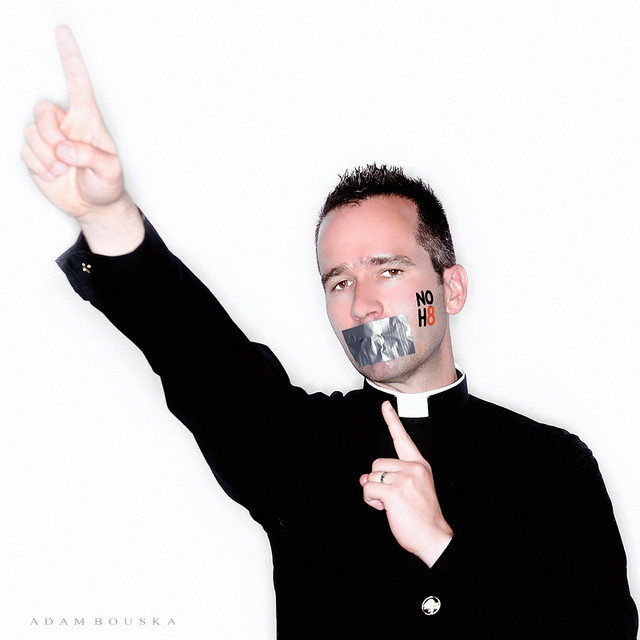
No Room for Hatred in My Faith, by Revd. Andy | NOH8 Campaign

Am very pleased to have my submission to the Be Heard section of the NOH8 Campaign's website featured.


My journey as a gay Christian, and an ordained Anglican Priest, has been an interesting and - at times - a painful one. It's been a journey of discovering who I am, and who I was created to be. As a gay Christian, it saddens me that I sit in the middle of two communities that are often at war with each other. However, I've gradually learned that I needn't be apologetic for being gay, or for having a faith. It saddens me that there are so many people who use their faith as a justification for their bigotry, and seek to belittle, ostracise or oppress the LGBT community. That's not the expression of faith that I have, and it is for this reason that I posed for the NOH8 Campaign ... there is no room for hatred in my faith, and there shouldn't be room for it in our communities.
-Reverend Andy